EVIDENCE SET 2
(TPA 4)
Teach and Manage
Student Learning
INTRODUCTION
This Evidence Set 2 refers to Teacher Performance Assessment 4 (TPA4) which focuses on teaching strategies and classroom management to maintain a supportive environment that caters to all students' learning needs.
CONTEXT
The following set of Evidence demonstrates my ability to select and evaluate which teaching strategies and resources would best assist with classroom management, communication and student engagement.
The following examples of evidence address these APST focus areas:
3.4 Select and use resources
3.5 Use effective classroom communication
4.1 Support student participation
4.2 Manage classroom activities
4.3 Manage challenging behaviour
6.3 Engage with colleagues and improve practice
Observations
In building my understanding of student behaviour of this complex cohort, I gathered evidence from observing them in class, reading their case files, analysed data and emails. This evidence demonstrates my ability to interpret information and strategies to consider in managing behaviour, such as observing non-verbal cues for future lessons (Focus Area 4.3).
Challenging Behaviour
Teacher Observation (by Peta Shannon)
Observing the emails for student behaviour is vital. Recently an email about one student in my Year 7 class who is notorious for behaving disrespectfully and was sent to the leaders. This email detailed the triggers to watch for when he is going to act aggressively such as pacing, face changes or voice deepening and the ways to manage his behaviour such as positive reinforcements for good interactions and to reward him with a break card, safe zones and people to talk to.
SUMMARY: Be vigilant with checking student data and school correspondence. Monitor student engagement and concentration via observing non-verbal cues.
Classroom Management
(Journal Entry by Peta Shannon)
For behaviour to be managed starts with good classroom practice. At XXX, staff are encouraged to provide students with consistent routines, lesson notes, assessment tasks, encourage respect, collaboration, inclusivity and positive interactions, clear expectations, provide structured, trauma-informed brain breaks to also manage personal needs during these breaks, record student movement and use visual cues for clarity, reduce information overload in slides and material with clear formatting and visual aids.
Each classroom has clear expectations on
posters in every classroom. Each classroom
has an SSO to support student learning and
manage any needs or behavioural issues.
If students become unmanageable, team
leaders are called to help resolve any issues
or conflicts.This system is monitored through
3 Tiers –
1) Green Light for staff abiding by
checking in with students with their current
zone of regulation and establishing routines
and reinforcing positive behaviours,
2) Yellow light staff will have a 1:1 conversation
with the student to gain understanding of the
behaviour being demonstrated, use classroom
expectations to explain why the behaviour is
inappropriate, negotiating a regulation activity
with the student and allowing space and time
for student to choose their activity, checking
back in with the student and communicating
behaviour and actions to the family and
3) Red Light staff will contact Student Services
for unsafe or wilful refusal to follow instructions, SSOs with contact leader to remove the student and the leader will remove the student and notify families of the behaviour and the next steps.

Managing Classrooms
This evidence details my observations of other teachers' strategies used within classrooms to manage student activities, support their participation and behaviour, and the information I had gathered about the school behaviour management policies. This would be instrumental for me to make informed decisions when managing the classrooms (Focus Areas 4.2, 4.3).
Purpose
In understanding the specific goals of the cohort, gathered from One Plans, previous assessment tasks and observations, I was able to ascertain what general capabilities and Drama skills I would need to assist in developing in alignment with the curriculum. Resources would be selected to fit within these goals and to support all learners
(Focus Area 3.4).
Selecting Resources
(Journal Entry by Peta Shannon)
What is the central teaching focus of your unit and planned lessons?
To build students’ script writing, characterisation and self-reflective capabilities. Due to students’ low levels of literacy and social awareness, this unit will help to build critical thinking, writing, collaboration and communication skills.
How will your lessons develop students’ skills, knowledge and understandings of the learning area?
Students understanding the style of parody and how to demonstrate this through creative writing and acting, they will begin to observe, respond and embody others’ vocal tone, facial expressions and body language so that they become more socially aware of others’ moods and therefore, build an awareness of self.
Communication Teacher Observation
(Journal Entry by Peta Shannon)
The teachers try to stay calm at all times. Walking around one student at a time.
Manners and structure are important here.
There is one student in the class who doesn’t like talking so the teacher lets her get on with her work. When talking to her, she gets down underneath so she squatted below her.
My mentor, always gives very clear instructions/learning intentions, stands near students and distracts them at times to maintain behaviour. She encourages students to use critical thinking and begins a lot of lessons with discussions to build their vocabulary and calm them, so they are ready to learn.
Communication Strategies
This evidence showcases how I was able to observe my mentor teacher as she interacted with my students so I could consider strategies for effectively communicating with students in future lessons. (Focus Area 3.5).
Collegial Engagement to Support Students
This evidence demonstrates my ability to observe and receive feedback from colleagues to find strategies that will support students with anxiety and/or depression to deregulate so they can return to regular lessons (Focus Areas 4.1, 6.3).

Observation of Mentor
(Journal Entry by Peta Shannon)
A student this morning came in and felt distressed. My mentor taught her a hand tracing technique to help calm her. In tracing her hand, the student began to calm down. This technique is called mindfulness to support interoception (the brain's ability to measure the body's state and therefore regulate emotions) to which may be useful for students with anxiety in future classes and my mentor sent me these links to find out more:
https://www.autism.org.uk/advice-and-guidance/professional-practice/interoception-wellbeing
ACTION
This section demonstrates the teaching actions taken to effectively use resources, communicate with students and manage engaging classroom activities and behaviour. Furthermore, it demonstrates the professional development undertaken with colleagues that would be used to improve best practice.
The following examples of evidence address these APST focus areas:
3.3 Use teaching strategies
3.4 Select and use resources
3.5 Use effective classroom communication
4.2 Manage classroom activities
4.3 Manage challenging behaviour
6.2 Engage in professional learning and improve practice
TEACHING STRATEGIES TO SUPPORT DIVERSE LEARNERS
Context Cohort description:14 x Year 7 mixed gender students who are all new to the school and to Drama. Students in this cohort have a range of interests from cars, gaming, gardening, coding, art, music, creative writing and basketball. There are often a lot of student absences, trauma backgrounds and diverse learning needs. Such as, 2 in a custody arrangement, some come from separated families, 4 x ASD, 4 x ADHD, 1 x OCD, 1 x ODD, 1 x Sensory Processing, 1 x Mild Intellectual Disability, 1 x Mild Hearing Loss, 1 x Dyspraxia, 2 x Social Anxiety.They have already completed a radio play based on selling a product using skills in script writing, voice work, performance, prop making and collaboration.
Theoretical and Pedagogical Framework
I use three pedagogies: Universal Design for Learning, I Do, We Do, You Do and Learning by Design.
Firstly using UDL, I have all students learning needs and will incorporate a variety of methods to help students learn such as clear instructions, visual aids, individual and group activities, brain breaks, etc. Through I Do We Do You Do, I will demonstrate how I would like them to perform, enable opportunities for them to apply their knowledge through activities with the whole class and then individually or with their groups. The Learning by Design is a multimodal literacy pedagogy whereby students learn to analyse multimodal texts, respond to them through verbal or written communication and then apply their knowledge through written, verbal or multimodal communication.
Teaching Strategies and Resources
This evidence demonstrates the complex teaching pedagogies, strategies, behaviour management strategies, brain break options, environment considerations, adjustments and resources required to meet the needs of all diverse learners in this complex class. (Focus Areas 3.3, 3.4, 4.3)
Adjustments to meet the needs of all learners
Teaching
-
Get to know the students
-
Encourage school attendance
-
Scaffolded teaching
-
Provide Differentiated learning tasks
-
Connect to real world contexts
-
Clear instructions
-
Ask students to repeat instructions
-
Engaging activities - have a list of games
-
Use social stories
-
Confidence building exercises
-
Character building exercises
-
Vocal exercises
-
Check ins and check outs
-
Brain Breaks
-
Monitor and observe social interaction and reward them with positive feedback
-
Develop their communication, creativity, self-autonomy and social skills
-
Consistent feedback with grading and positive reinforcement
-
Consistently refer back to the learning intentions
Behaviour Management
-
Give roles e.g director of the day
-
Make sure instructions are clear
-
Teach social emotions
-
Use positive reinforcements
-
Clear consequences
-
Adjust content, process and work products where necessary
-
Keep students engaged
-
Negotiate learning goals
-
Provide work examples
-
Read students’ facial expressions
-
Give brain breaks as rewards such as the following games:
Two truths one lie, Heads and Tails, The Bubble (personal space), Museums, Guess the Mime, Play Music - close eyes and later describe what you see, Queen’s Garden, Simon Says, Would you rather?, Keep the balloon up in the air, Celebrity Head, Hangman, Verbal Tennis, Cheese Shop (Do you have any .. No and excuse why with no expression) No smiling or laughing, Count to 21
Environment
-
Classroom 1 - has a typical classroom with desks and smartscreen
-
Classroom 2 - Black Box Style Drama Room
-
Create a sense of belonging with posters about themselves
-
Provide tactile objects
-
Create a calm environment with music
-
Provide Visual cues
-
Create ‘safe’ zones in the classroom and personal spaces
-
Drop Down Screen and Projector for slides and videos to be played.
-
Seated Auditorium useful to observe others and to watch performances.
-
White Board for Ideas and Discussions.
-
White board with classroom tasks outlined to keep students on task
Resources
-
Poster
-
Coloured pencils
-
Paper
-
Music player
-
Posters
-
Smartboard
-
Laptops
-
Examples, and videos to keep students engaged
-
iPads/Laptops to record voices and useful for meditation tracks for performance anxiety if necessary
-
Cameras, tripods, clapperboard
-
Modified Task Sheets
-
Reflection Sheet
-
Props for ADHD student to use as a ‘fidget’ them stay focused during performance
-
Brain Break props
Resource:
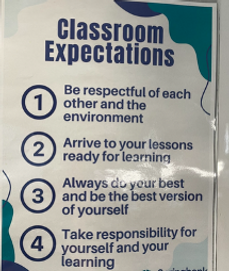
Classroom Expectations
I selected and used the school's Classroom Expectations to support student participation and referred it prior to the commencement of lessons and as reminders to students when they may not have been behaving appropriately
(Focus Area 3.4, 4.3).

Classroom Management
In managing the class, I created a slideshow that would give clear instructions on the entry tasks (to engage and motivate students to learn and to give time for late comers to settle), learning intentions, lesson plans and success criteria. I also had set timers for brain breaks and activities
(Focus Area 4.2).
Professional Learning
This evidence shows my participation in the Understanding and Responding to Trauma SMART SMART by the Australian Childhood Foundation. In working with colleagues, discussions and group activities helped to provide me with further insight in the strategies necessary to support students with traumatic backgrounds or diverse learning needs, such as connection to body and breathing exercises (Focus Area 6.2).


Selecting Resources
These are examples of two videos I selected to use in lessons to engage students in understanding how to use their facial expression, body language and voice to convey meaning. (Focus Area 3.4).


Scaffolding Resources
These are examples of two scaffolded templates that were designed by me to support students in writing their scripts. The one below was designed specifically for a student with high learning needs (Focus Area 3.4).
RESULTS
The following evidence demonstrates the impact I had on students’ learning and behaviours from the effective communication, strategies, resources and professional learning and engagement I had used to create an inclusive, engaging and positive classroom environment.
The following examples of evidence address these APST focus areas:
3.3 Use teaching strategies
3.5 Use effective classroom communication
4.1 Support student participation
4.2 Manage classroom activities
4.3 Manage challenging behaviour
6.3 Engage with colleagues and improve practice
6.4 Apply professional learning and improve student learning

Engaging Lessons
This evidence demonstrates how I am able to manage classroom activities with clear instructions on the powerpoint slide, engagement activities and communication skills. Students were engaged with the lessons due to my ability to focus and maintain their attention with simple verbal cues such as clapping my hands, an engaged facial expression and eye contact, positive reinforcements and games such as Draw a Cat aka Hangman. Moreover, statements such as "Good to see you back in class" also give students whose attendance rates are low a sense of encouragement to attend lessons.
(Focus Areas 3.5, 4.1, & 4.2).
Managing Classroom Activities with Non-Verbal Communication
This is a photograph of the emoji cards I gave students whilst they were writing their scripts. As some students wished to be left alone to concentrate or found difficulty verbally communicating when they needed help, this was an excellent non-verbal communication strategy to support their learning
(Focus Area 3.3, 3.5).


Teacher Modelling to Support Learners
This photographs demonstrates how I would sometimes demonstrate to students how to use facial expressions and body language to convey meaning. This is the I Do, You Do, We Do approach whereby seeing me demonstrate first, gave the students the confidence to experiment themselves individually and then with others. (Focus Area 3.3, 4.1).
Reviewing and Improving Practice
This evidence demonstrates my ability to collaborate with staff to evaluate what teaching strategies were effectively working for the engagement and motivation of students in Drama classes and what areas needed room for improvement. (Focus Area 6.3).
Staff Meeting - Performing Arts Review
(Journal Entry by Peta Shannon)
Today we had a Performing Arts Curriculum Review at our staff meeting. In achieving Student Engagement and Motivation, my mentor, music teacher and I discussed how we have been using lots of games, autonomous learning, student led learning through giving them choices, group activities, providing them with opportunities to set goals and treating them like a theatre company for a sense of belonging. We both agreed that the engagement and motivation of students is because they take ownership of their work and gain peer support through performances.
Things we felt could improve were in collaborating more with each other across Drama and Music and monitoring student progress through building data that is consistent across all subjects.
Student Progress (Managing Challenging Behaviour and Trauma)
(Journal Entry by Peta Shannon)
STUDENT A
Day 1
My other student is very distant and did not want to communicate with me. He even told me to go away.
Day 2
Student A walked out of class when he realised he did not have a script. I talked to him about his passion for costumes and asked if he wanted to help with costume decisions for the other students. He looked me in the eye for the first time and went back to class.
Day 3
Strategies for working with Student A
Use his interests in art and history to get his attention as well as calm instructions, positive reinforcement, reminders of appropriate behaviour, modelling my respect and manners for him to enable him to do the same, walking at a close distance but not to invade his space. He seems to respond to me well by doing these things.
Day 4
Student A was particularly engaged and even stood up in front of the class and talked about his work which boosted his confidence and vocal skills.
Day 5
Student A was engaged in performance today via placing a hat on his head to become a character. He used his body language, gestures and voice to impersonate his character.
STUDENT B
Day 1
One of my students is a very reserved student and initially sat at her desk with her head down. When talking to her, I discovered that she loves to draw and write with a pen. Knowing this, I gave her the option to storyboard her ideas. From there, I told her to tell me the story. She was able to give me much verbal information to which she was then able to write down her ideas.
Strategies for working with Student B
Many students like Student B low literacy and social anxiety in this cohort and they will need much encouragement, clear instructions, positive reinforcement when they are on task, check-ins and simple checklists to help them evaluate their learning.
Day 2
Student B showed a lot of confidence as I gave her the opportunity to be the whiteboard marker.
Day 3
One student froze when making her attempt, (I had remembered in my studies that anxiety can cause the broca to stop working which is the part of the brain that activates speech, Talwar, 2007, as cited in Gray, 2019) but I told her that just standing up in front of others was great, as this is building her confidence. At the end of the lesson, I sat with her and communicated with her via her writing to me on her laptop about how she was feeling to ensure she felt supported and safe. She then told me she was going to lunch to get a hug from a friend which indicated to me that she was able to re-regulate and seek supportive networks.
Day 4
Student B also achieved today as she sat and read in front of the class which she would not have done in previous lessons. She showed good projection and posture demonstrating her confidence has improved.
Professional Learning and Teacher Strategies towards Student Success
This evidence shows that over time I can build effective teacher-student relationships whereby trust is formed and I am able to manage challenging behaviour and use professional learning experiences such as trauma informed practice, to use effective methods to calm students' anxiety and build their confidence.
(Focus Areas 4.3, 6.4).
EVALUATION
The following evidence is a collection of self-reflections, mentor and university liaison responses to the effectiveness of my teaching strategies and classroom management.
The following examples of evidence address these APST focus areas:
3.3 Use teaching strategies
3.4 Select and use resources
3.5 Use effective classroom communication
4.1 Support student participation
4.2 Manage classroom activities
4.3 Manage challenging behaviour
Self-Reflection
(Journal Entry by Peta Shannon)
Through my explanation, I was very animated with my gestures and facial expressions and ensured I maintained eye contact with all students. Students’ non-verbal responses (such as smiling or looking back at me) showed they were engaged in learning and understanding, and also verbally repeated what I just said. Through my high level of interaction and demonstrational skills, students were eager to participate in the “Greetings Your Majesty” activity (where one student closes their eyes and has to guess another student who will use a different voice to say “Greetings Your Majesty”) and all bar three had a go.
Effective Teaching
This evidence shows my ability to use effective communication with students so that they are engaged and learning. My enthusiastic and modelling approach (using the I Do, We Do, You Do strategy, Killian, 2015) inspired students to participate in the activity with confidence.
(Focus Areas 3.3, 3.5, 4.1).
Effective Teaching Strategies and Use of Resources
These observations were taken from one lesson and demonstrate how effective I was at using teaching strategies and resources to ensure students were focused, engaged, learning, critically and creatively thinking, and building their understanding of Parody and other conventions of Drama
(Focus Areas 3.3, 3.4).
Liaison Observations - Effective Teaching Strategies and Resources
You gave an instruction at one point and realised the students were getting books still so you stopped, waited until they were in their seats then restated.
You reintroduced ideas and content from previous lessons so students are invited to revisit the ideas that underpin the current content, showing you have knowledge of content and can use this knowledge to create interesting lessons.
Drawing out students’ critical thinking by using more analytical questions.
Lots of exemplars given to students as examples before they write their script for the task.
Used engaging hooks to that appealed to the students to represent the meaning of parody.
Liaison Observations - Effective Teacher Communication
Good movement around room and checking in with students to help them activate their feedback or to scribe for students who needed it.
Great relationship building through greetings and getting down to the students level when you supported them with their work.
Direct use of individual student’s name used gently to keep them focused.
Good positive voice modulation to get attention when needed and redirection using humour to shut down low level inappropriate language.
Moving in and around the students is important behaviour management strategy.
Engaged student attention in a kind way way needed “xxx eyes up please”, “Boys heads up please” & "All eyes to me”.
Effective Communication
These observations were taken from one lesson and clearly demonstrate my effective communication skills in moving about the room to maintain focus, address students by their name, use appropriate and positive vocal modulation to get attention, use positive phrases to grab attention and get down to students level when supporting their work. All these strategies have helped me to create great teacher-student relationships to support their learning (Focus Area 3.5).
Support Student Participation
The following observations from my mentor and liaison were taken from one lesson and clearly demonstrate my ability to support and activate student participation through my use of the Inclusive Model, humour, respect, patience and time spent with them to complete tasks, emoji cards, addressing them by their names and a timer. Thus, built a warm and trusting environment.
(Focus Area 4.1).
Mentor Observations - Supporting Student Participation
Great to see that more students come along the journey of connecting with each other. Feeling safe and connected in the Inclusive Model.
Fair and consistent and a little bit of humour used. Respectful of students not to volunteer.
After the game I felt that Student E was more connected to the task. Well done. It’s the relationship building that makes what we do vital to have students on task.
Great working with Student J as he really worked with you to get the task done.
Liaison Observations - Supporting Student Participation
Good to remind students about requiring support in a non- verbal way through smiley face if you do not need support and sad face if you need support.
Engaged the students well including using their names.
Obvious that you are building a warm, and trusting learning environment.
Very good addition of the timer to activate students to participate in the final part of the entry task.
The students are excited about the task.
Mentor Observations - Effectively Managing Classrooms
Working on skills and particularly voice work. A great reminder of the accent work that we did earlier in the year. Speaking in the accent was excellent as it meant that the ‘audience’ had to listen and watch the person who was creating the voice.
Liaison Observations - Effectively Managing Classrooms
Very well managed given the learning needs and limited attention span of the students.
Routines were clearly being established.
The way students enter the classroom and leave the classroom effectively.
Good strategies to keep the tone of the class managed from the beginning.
Good balance of direct instruction and independent work…the students settled well when they worked independently and the addition of music was a great settling technique.
Effective Classroom Management
These observations were taken from one lesson and clearly demonstrate my ability to manage students with diverse learning needs and limited attention spans as I had established clear routines and tone, expectations on entries and exits, used direct instructions and supported independent work through settling techniques
(Focus Area 4.2).
Effective Management of Challenging Behaviour
This evidence reveals how my mentor teacher had observed how had effectively managed and engaged a student in learning whose behaviour was challenging. His behaviour improved in my classes as I used visual cues, engaging games and focused on his interests. (Focus Area 4.3).
Mentor Observations - Managing Challenging Behaviour
I really like the fact that you built in the non-verbals to manage challenging behaviours.
Good introduction with the quick games and Student A was also involved so Kudos to you.
Good work with Student A kept him engaged and in the class throughout and he really liked the drawing activity first up and the fact that he shared this this with the whole class is good for confidence building and public speaking.
Liaison Observations - Managing Challenging Behaviour
Student behaviour well managed.
The Graduate Teacher level APST focus areas addressed in this Evidence Set are:
3.3, 3.4, 3.5, 4.1, 4.2, 4.3, 6.2, 6.3 & 6.4
STANDARDS
To view how my teaching addresses the APST focus areas, click on the evidence listed below:
PROFESSIONAL PRACTICE
3 Plan for and implement effective teaching and learning
3.3 Use teaching strategies
(Evidence 28), (Evidence 35),(Evidence 36), (Evidence 39), (Evidence 40)
3.4 Select and use resources
(Evidence 25), (Evidence 28), (Evidence 29), (Evidence 32), (Evidence 33), (Evidence 40)
3.5 Use effective classroom communication
(Evidence 26), (Evidence 34), (Evidence 35) (Evidence 39), (Evidence 41)
4 Create and maintain supportive and safe learning environments
4.1 Support student participation
(Evidence 27), (Evidence 34),(Evidence 36), (Evidence 39), (Evidence 42)
4.2 Manage classroom activities
(Evidence 24), (Evidence 30),(Evidence 34), (Evidence 43)
4.3 Manage challenging behaviour
(Evidence 23), (Evidence 24), (Evidence 28), (Evidence 29), (Evidence 38), (Evidence 44)
PROFESSIONAL ENGAGEMENT
6 Engage in professional learning
6.2 Engage in professional learning and improve practice
6.3 Engage with colleagues and improve practice
6.4 Apply professional learning and improve student learning

REFERENCES
-
Australian Childhood Foundation (2025) Understanding and Responding to Trauma SMART Workshop https://www.childhood.org.au/
-
Australian Curriculum Assessment and Reporting Authority (ACARA) (2025) https://www.australiancurriculum.edu.au/
-
Australian Institute for Teaching and School Leadership (AITSL) (2017) Teacher Standards https://www.aitsl.edu.au/standards
-
BitterBuffalo (2015) Body Language: Examples of Postures from TV Talk Shows https://www.youtube.com/watch?v=i659gDFoBrE. YouTube
- Department of Education (2023) Behaviour Support Toolkit. Government of Aouth Australia.
- Goodall, E. (2022) Interoception and Mental Wellbeing in Autistic People https://www.autism.org.uk/advice-and-guidance/professional-practice/interoception-wellbeing. The National Autistic Society (2025).
-
Killian, S. (2015) The I Do WE do YOU do Model Explained. Evidence-Based Teaching https://www.evidencebasedteaching.org/the-i-do-we-do-you-do-model-explained/
-
Robson, G. (2021) Interoception: The Hidden Sense that Shapes Wellbeing https://www.theguardian.com/science/2021/aug/15/the-hidden-sense-shaping-your-wellbeing-interoception. The Guardian
-
ScreenSlam Toy Story: Tom Hanks Tim Allen, Cast Voice Recording Behind The Scenes (Broll) https://www.youtube.com/watch?v=CJpCUTPYdOg. YouTube.
-
WatchMojo.com (2014) Top 10 Late Night Talk Show Hosts YouTube.